


Three-phase transformers are key players in today’s power systems.
They efficiently step voltages up or down, ensuring stable energy flow for transmission and distribution.

From powering factories and office buildings to supporting utility grids, these transformers are essential in industrial, commercial, and infrastructure applications where reliable performance is critical.
What Is a 3 Phase Transformer?

A 3-phase transformer is an electrical device that transfers power between circuits using electromagnetic induction, but with a key difference—it operates through three sets of primary and secondary windings.
These windings support balanced and efficient power delivery across three conductors.
Three-phase systems use alternating current (AC) signals that are offset by 120°, creating a constant and smooth power flow.
This results in greater efficiency, reduced conductor loss, and stable voltage levels.
Compared to single-phase systems, three-phase systems can carry more power using smaller and lighter wiring.
3-phase transformers are essential in large-scale power transmission, heavy industrial machinery, and commercial infrastructure.
They play a critical role in powering everything from electrical substations to large manufacturing plants, making them a cornerstone of modern electrical networks.
How Does a 3 Phase Transformer Work?

A 3-phase transformer works on Faraday’s Law of electromagnetic induction, which states that a changing magnetic field induces voltage in a nearby conductor.
When AC current flows through the primary windings, it creates an alternating magnetic flux in the transformer’s laminated core.
This flux links to the secondary windings and induces a corresponding voltage.
The amount of voltage induced depends on the turns ratio between the primary and secondary coils—stepping voltage up or down as needed.
Throughout this process, the frequency remains unchanged, ensuring compatibility with the system’s electrical standards.
This seamless energy transfer makes 3-phase transformers ideal for efficient, high-power applications.
Construction of a 3 Phase Transformer
A 3-phase transformer is built to handle high power efficiently and safely.
There are two primary construction types:
Core-Type: Features three vertical limbs, each with HV (high voltage) and LV (low voltage) windings. Magnetic paths are interlaced to distribute flux evenly.
Shell-Type: More compact, with five limbs enclosing the windings. This design reduces height and improves shielding between phases.
In both types, LV windings sit closer to the core for easier insulation, while laminated silicon steel cores help reduce eddy current losses.
Other critical components include:
Insulation (paper, epoxy, or oil) to prevent shorting,
Cooling medium (air for dry type, oil for liquid-filled) to manage heat,
Buchholz relay for gas detection during internal faults,
Voltage regulators to maintain output stability,
Oil conservators to manage thermal expansion,
Breathers to keep moisture out of transformer oil.
Each part ensures the transformer operates safely, efficiently, and with long service life.
Common Winding Configurations (Delta & Wye)

Three-phase transformers use Delta (Δ) and Wye (Y) winding configurations depending on load requirements and system design.
Delta (Δ): Forms a closed loop with no neutral connection. It’s ideal for heavy or unbalanced loads and is more fault-tolerant. Common in transmission networks.
Wye (Y): Windings connect at a neutral point, supporting both three-phase and single-phase loads. Widely used in distribution systems.
Understanding their voltage and current relationships is key:
In Delta: VL = VP, IL = √3 × IP
In Wye: VL = √3 × VP, IL = IP
The chosen configuration affects phase shift, grounding options, and the transformer’s behavior under load—making it a vital decision in system planning.
Types of 3 Phase Transformer Connections
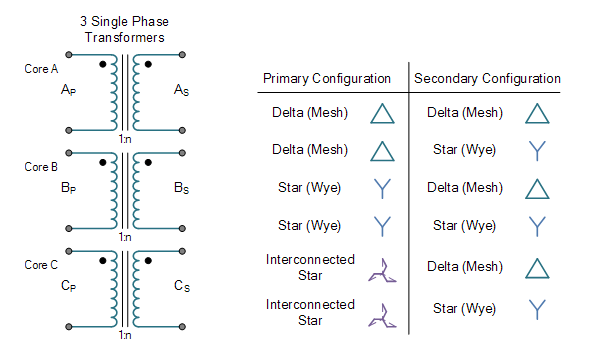
Star-Star (Y-Y)

This configuration connects both primary and secondary windings in a star (wye) pattern, providing a neutral on both sides.
It’s cost-effective and efficient for balanced loads but may experience instability with unbalanced or nonlinear loads without grounding or tertiary winding support.
Delta-Delta (D-D)
In this setup, both windings form a closed triangle (delta).
While it lacks a neutral, it’s robust under unbalanced conditions and can continue operating even if one transformer fails—known as open delta or V-V operation.
Delta-Star (D-Y)

A common choice in power distribution, this connection features a delta primary and star secondary.
It introduces a neutral point, making it suitable for supplying both three-phase and single-phase loads.
A 30° phase shift occurs between primary and secondary.
Star-Delta (Y-D)
This setup is typically used in substations for voltage step-down.
The star-connected primary handles high voltage efficiently, while the delta secondary supplies low-voltage three-phase power.
Also introduces a 30° phase shift, useful for certain power system designs.
Open Delta (V-V)

A backup method using two transformers instead of three.
It supplies three-phase power at 57.7% capacity, used when a third unit fails or isn’t needed.
Scott-T Connection

This specialized connection converts 3-phase to 2-phase power, ideal for running legacy two-phase equipment or powering specialized machinery from standard three-phase supply.
Key Applications

Before we wrap up, let’s take a quick look at where 3-phase transformers are most commonly used.
Their efficiency, reliability, and power-handling capabilities make them essential in various sectors:
Power generation and transmission grids
Industrial automation systems
HVAC and motor drive units
Mining and petrochemical equipment
Commercial and residential power distribution
Electric furnaces and rectifier systems
Conclusion

Three-phase transformers play a vital role in stable, efficient energy distribution across industries.
Their design and configurations are key to reliable performance.
Need help selecting or customizing a transformer? Contact our team for expert advice tailored to your specific application and power system requirements.

 English
  Spanish
  Russian
  Italian
  German
  Chinese