


Electric motors convert electricity into mechanical power, reliably driving devices from home appliances to industrial machines.

Choosing between single-phase and three-phase motors depends on your power needs and application. Understanding their differences helps you select the right electric motor for better efficiency and performance.
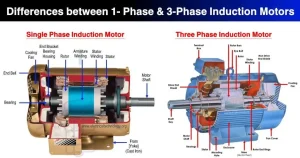
Single-Phase Motors Explained

Single-phase motors run on a single-phase AC power supply with two wires: one live wire and one neutral wire.
They feature a simple design and are commonly used for light-duty applications. Since they don’t create a rotating magnetic field naturally, they need a starting device like a capacitor to begin operation.
These single-phase motors offer limited torque and are best suited for low-power applications.
Common types of single-phase motors include:
- Capacitor-Start Motor – High starting torque for heavier loads.
- Capacitor Start and Run Motor – Smooth starting with better running efficiency.
- Split-Phase Motor – Simple design for light-duty applications.
- Shaded Pole Motor – Low-cost option for small, low-power equipment.
Three-Phase Motors Explained

Three-phase motors run on a three-phase AC power supply, using three alternating currents spaced 120° apart to deliver smooth and continuous power.
Meanwhile,three-phase motors provide higher torque, better efficiency, and are ideal for industrial applications.
Common types of three-phase motors include:
- Squirrel Cage Motor – Durable, low-maintenance, and widely used in industrial applications.
- Wound Rotor Motor – Provides high starting torque for heavy-load applications.
Single-Phase vs. Three-Phase: Key Differences

Provide a comparison table or bullet summary including:
Applications and Use Cases

Single-phase motors are ideal for homes, small workshops, and light-duty applications, including fans, pumps, air conditioners, and small power tools.
On the other hand, three-phase motors are ideal for industrial applications, powering heavy machinery, conveyors, compressors, and other high-load equipment in manufacturing plants.
Motor Performance and Efficiency

They offer a longer service life and higher efficiency.
In comparison, single-phase motors cost less but produce more vibration, provide lower torque, and wear faster under heavy-duty use.
Power Supply and Voltage Requirements

Single-phase motors typically operate on 120V or 240V power. Because they draw higher current, they usually require thicker wiring.
Three-phase motors typically operate on 208V or 480V power. By distributing current evenly across three phases, they achieve higher efficiency and smoother operation.
In addition, three-phase motors handle starting and running loads more efficiently, making them ideal for large-scale industrial applications.
Cost and Long-Term Value

Single-phase motors have a lower upfront cost and are easy to install and maintain, making them ideal for residential and light commercial applications.
By comparison, three-phase motors cost more initially and need more complex wiring, but they deliver lower operating costs, less maintenance, and better performance in industrial applications over time.
Conclusion

The right motor depends on your application.
Single-phase motors are best for low-power applications, while three-phase motors are ideal for high-efficiency and heavy-duty industrial applications.
Need help choosing the right motor? Contact us today for expert advice and a motor solution that fits your power and performance requirements.
FAQs About Single-Phase and Three-Phase Motors
Do I need single-phase or three-phase?
If you use home appliances or light-duty equipment, a single-phase motor is usually enough. For industrial applications and heavy-duty equipment, a three-phase motor offers higher efficiency and better reliability.
Is 240V single-phase or three-phase?
240V can be single-phase or three-phase. In a single-phase system, it uses two hot wires. In a three-phase system, 240V is the voltage between two phases. A transformer is often used to provide 240V single-phase from a three-phase supply.

 English
  Spanish
  Russian
  Italian
  German
  Chinese