


Stator core laminations are essential in electric motors, helping boost efficiency, reduce power loss, and manage heat.

These laminations are made from stacked, insulated steel sheets that minimize electromagnetic inefficiencies like eddy currents and hysteresis loss.
Their design ensures motors run cooler, quieter, and more reliably in demanding applications.
What Are Stator Core Laminations?

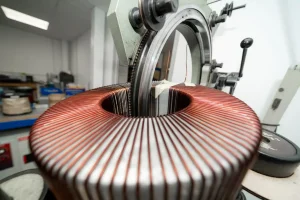
Stator core laminations are thin sheets of electrical or silicon steel, carefully stacked and insulated to form the core of an electric motor.
This layered structure supports the motor windings and serves as a crucial part of the magnetic circuit.
By efficiently channeling magnetic flux, stator laminations help convert electrical energy into mechanical motion while minimizing energy losses.
Why Are Stator Cores Laminated?
Reduce Eddy Current Loss: Alternating magnetic fields induce eddy currents in the core, which waste energy as heat. Laminations break up these currents, minimizing power loss.
Minimize Hysteresis Loss: As magnetic fields change direction, the core undergoes repeated magnetization. Laminated steel has narrow hysteresis loops, reducing energy lost in this magnetization-demagnetization cycle.
Improve Cooling: Laminations help lower the core’s internal temperature, allowing better airflow and heat dissipation, which prevents overheating and extends motor life.
Materials Used for Stator Laminations
Silicon Steel

Silicon steel is the go-to material for most stator laminations. It offers low core losses, high magnetic permeability, and performs well under alternating magnetic fields—making it ideal for efficient, everyday motor applications. Its balance of cost and performance makes it the industry standard.
Nickel & Cobalt Alloys

Nickel and cobalt alloys are reserved for high-performance or specialized motors, such as those used in aerospace or medical equipment.
These materials support higher flux densities and offer superior thermal and magnetic stability, though they come at a higher cost.
Design & Manufacturing Process

Designing stator core laminations starts with selecting the right sheet thickness, typically ranging from 0.004” to 0.025”, depending on the motor’s efficiency and size needs.
These thin steel sheets are carefully stacked to form the complete stator core, ensuring consistent magnetic properties throughout.
Manufacturing uses precision tools like stamping dies, CNC laser cutters, and wire EDM machines to achieve exact profiles and tight tolerances.
Once the laminations are cut, they are assembled using finger plates, compression rings, or bolts to maintain structural integrity and alignment.
Additional treatments may follow, including annealing to relieve stress, insulating coatings to reduce eddy currents, and grinding to ensure smooth surfaces and tight tolerances.
These steps ensure each stator core meets performance standards and delivers uniform magnetic behavior and dimensional stability, even under high-stress conditions.
Cooling & Thermal Management Role

Stator core laminations play a key role in managing heat within electric motors.
Their layered design allows air or hydrogen to circulate through the core, efficiently dissipating heat generated during operation.
This airflow prevents excessive temperature buildup and keeps the motor running within safe thermal limits.
By maintaining an optimal operating temperature, laminations help reduce the risk of overheating, insulation breakdown, and mechanical failure.
This not only extends the motor’s lifespan but also ensures stable performance under continuous or heavy loads—especially in high-efficiency and high-power applications.


 English
  Spanish
  Russian
  Italian
  German
  Chinese