


| Aspect | Stepper Motors | Servo Motors |
|---|---|---|
| Control System | Open-loop, no feedback, simpler to use | Closed-loop with sensors or encoders |
| Hybrid Option | Closed-loop steppers offer partial feedback | Standard servos always use feedback |
| Torque at Low Speed | High starting torque, good at low speeds | Consistent torque across wide speed range |
| Torque at High Speed | Torque drops quickly at higher speeds | Maintains strong torque at high speeds |
| Efficiency | Less efficient, constant current draw | High efficiency, current adjusts to load |
| Heat Generation | Runs hot, even when idle | Cooler operation due to smart current use |
| Inertia Handling | Handles ~10× its own rotor inertia | Handles up to ~100× rotor inertia |
| Cost | More affordable | More expensive (motor + controller) |
| System Complexity | Easy to set up and control | Requires tuning and closed-loop setup |
| Positioning Accuracy | Good repeatability, limited correction | High precision with dynamic adjustment |
| Reliability | Reliable for consistent, simple motions | Reliable under varying loads and speeds |
| Best For | 3D printers, CNCs, low-cost robotics | Industrial automation, dynamic robotics |
When it comes to motion control, stepper motors and servo motors are two of the most common options you’ll run into. But they work in very different ways—and choosing the right one depends on what your project needs.
What Is a Stepper Motor?

A stepper motor is a type of motor that moves in small, equal steps. It doesn’t need a feedback system to know its position. This is called open-loop control. You simply send signals that tell it how many steps to move—and it does it. That makes it ideal for applications where position and speed are predictable and repeatable.
Simple design means it’s easy to control.
Great for low-speed precision like in 3D printers, basic CNC machines, or camera sliders.
But: it can lose steps if overloaded and doesn’t know unless sensors are added.
What Is a Servo Motor?

A servo motor, on the other hand, uses closed-loop control. It has built-in feedback—usually from an encoder—that constantly tells the controller the motor’s actual position. That means it can correct itself in real-time and maintain high accuracy even under varying loads or speeds.
Highly accurate and efficient across a wide speed range.
Ideal for demanding applications like robotics, industrial automation, and high-speed packaging machines.
It’s more complex and expensive—but much smarter.
Control and Feedback Systems
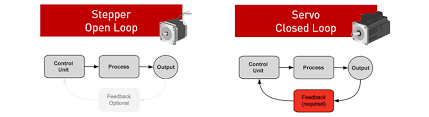
One of the biggest differences between stepper and servo motors is how they control motion.
Stepper motors run in an open-loop system. That means they follow commands without checking if the movement actually happened. This makes them simple and cost-effective—perfect for low-budget projects with predictable loads.
Servo motors, however, use closed-loop control. They constantly monitor their position and speed using encoders or sensors. If something goes wrong—like unexpected resistance—they correct it immediately. This gives you precise, real-time control.
⚙️ Hybrid Option: Some modern stepper motors now come with feedback systems, called closed-loop steppers. These offer better reliability without the full complexity (or cost) of servos.
Torque & Speed Performance

Let’s talk power and speed—two major performance factors.
Stepper motors shine at low speeds. They provide high torque at startup and are great for slow, controlled movements. But as the speed increases, their torque drops quickly.
Servo motors maintain strong torque across a wide range of speeds. They’re built for high-speed and high-performance tasks, with smooth acceleration and better dynamic response.
If your application needs to move fast and still deliver torque—servos win.
Efficiency, Heat & Inertia Handling

There’s more than just power—you also want efficient, cool-running motors that can handle real-world conditions.
Stepper motors, because they always draw current, tend to run hot, even when idle. They’re less efficient since they don’t adjust based on load.
Servo motors are much more energy-efficient. They pull only the current needed for the job, which means less heat and longer lifespan.
When it comes to handling inertia, servos are also superior. They can control loads up to 100× their own rotor inertia, while steppers usually manage about 10×.
Cost & System Complexity
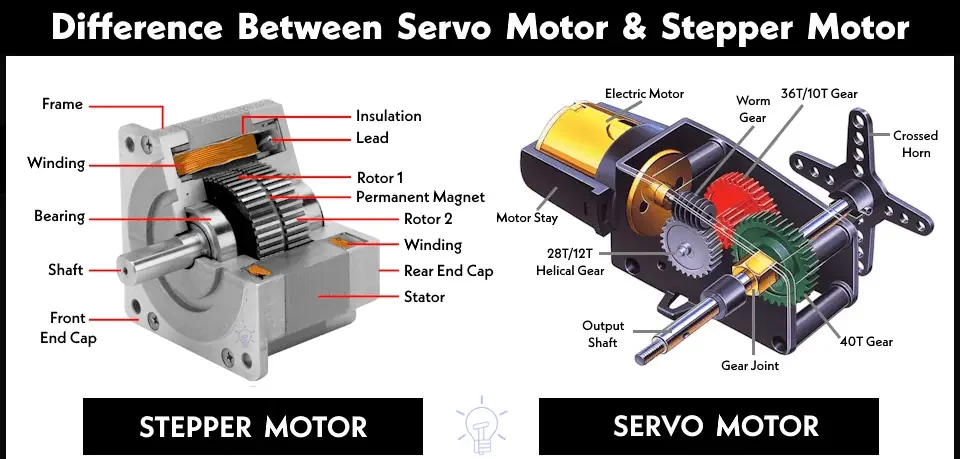
When it comes to budget and build, stepper motors have a clear advantage.
Stepper motors are cheaper and much easier to implement. You don’t need complex controllers or feedback systems. That makes them perfect for DIY builds or cost-sensitive projects.
Servo motors require more investment—not just for the motor itself, but also for the encoders, sensors, and closed-loop control systems. Plus, they often need fine-tuning to achieve optimal performance.
So if you’re on a tight budget or working on a simple system, steppers may be your go-to.
Positioning Accuracy & Reliability

Accuracy matters—especially in precision-driven applications.
Steppers provide excellent repeatability, especially in tasks that don’t need feedback correction. They’re reliable for making the same movement over and over again.
Servos win when you need high-precision positioning. Thanks to encoders and PID control, they constantly adjust themselves for accurate, smooth motion—even with changing loads.
In short: if you’re aiming for ultra-precise, dynamic positioning, servos are the better bet.
Ideal Applications by Use Case

Choosing the right motor really depends on what you’re building:
✅ Stepper Motors are best for:
- 3D printers
- Basic CNC machines
- Simple pick-and-place robots
- Any low-cost, low-speed precision task
✅ Servo Motors are ideal for:
- High-speed packaging equipment
- Industrial automation
- Robotics with dynamic movements
- Heavy-load, high-performance systems
Each motor has its strengths—and when you match the right one to the job, you get smoother performance and better results.
Future Trends & Tech Enhancements
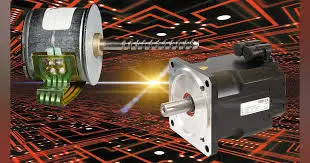
Both stepper and servo motor technologies are getting smarter and more efficient.
Closed-loop stepper motors are on the rise. These hybrids add encoders to traditional steppers, offering better accuracy and reliability while keeping costs down. They’re great for avoiding missed steps without needing a full servo system.
Anti-resonance control and microstepping advancements are making steppers smoother and quieter—ideal for applications like 3D printing and light automation.
Servo motors are seeing upgrades too. With high-resolution encoders, adaptive tuning, and smart drives, they deliver better performance in real-time control, energy savings, and predictive maintenance.
As these technologies continue to evolve, the line between stepper and servo is blurring—giving engineers more flexible, efficient options than ever before.
Conclusion

Choose stepper motors if your project needs simple, low-cost motion with good precision at low speeds. Go with servo motors when high speed, dynamic loads, and top-level accuracy matter.
Need help choosing the right motor for your system? Contact us today for expert guidance and customized motion control solutions.
FAQs
What are the disadvantages of a stepper motor?
They can lose steps under heavy load without detecting the error since they typically run open-loop
They consume full current even when idle, leading to inefficiency and heat build-up
They have reduced torque at high speeds and can become noisy during operation.
Which is better: stepper or continuous servo?
Continuous-rotation servos offer smooth rotation and built-in feedback, ideal for dynamic speed control
Stepper motors excel at precise, incremental movement and are simpler to control—but lack feedback and may need homing.
Can a stepper motor be used as a servo motor?
Not directly. A standard stepper has no feedback and needs homing on startup to know its position. Without sensors or encoders, it can’t dynamically correct its position like a servo.
Are servos or steppers more expensive?
Generally, servo motor systems are more costly due to the inclusion of sensors, closed-loop controllers, and tuning requirements. Steppers remain a more affordable, simpler option for basic positioning tasks.


 English
  Spanish
  Russian
  Italian
  German
  Chinese